
Running training plan generator (5K to 100-mile ultra)
Build a personalized half marathon, marathon, or ultra training plan around your race date and current mileage. Road and trail, any distance, any level.

Many running training plans are written for a runner who doesn't exist. A fixed number of weeks, a fixed starting mileage, and a race date that happens to fall in a convenient round number of weeks from today.
Real training doesn't work like that. You have a specific race on a specific date, a current fitness level that's yours alone, and a realistic number of days each week you can actually run. A good training plan works around all of that; not in spite of it.
Our running training plan generator builds your plan from scratch. Enter your race date, your current weekly mileage, your experience level, and your goal. Your complete week-by-week training schedule is ready in seconds, covers every session from Monday to Sunday, and prints beautifully on a single page (or two if need be).
It works for every distance from 5K to 100-mile ultramarathon, for both road and trail, and factors in any elevation gain your race may include - yes, it's super smart!
It's also free for Trail & Kale members, subscribe below to reveal it, or read on to learn more about how this gem-of-an-app works.
⬆ Ready to gain access to OUR tools for Runners & HIKERS?
Subscribe to a free account to reveal our Training Plan Builder and get extra perks like access to exclusive content, training tools, gear roundups, community comments, and our newsletter.
If you're completely new to running, or coming back to it after a long break, I'd recommend using our Couch To Runner Training Plan generator, instead; it's a better route to becoming a runner again, while avoiding any chance of picking up injuries.
Couch to 5K, 10K, Half Marathon Training Plan Generator
Build a free couch to half marathon training plan from scratch. Also covers couch to 5K and 10K. Beginner-friendly, road and trail, starting from zero.
 Alastair Dixon
Not sure where to begin when it comes to managing training, life, and have questions about where to run, and what to wear? Read our guide on how to start running for beginners.
How to Start Running for Beginners: the Complete Guide (2026)
Everything you need to know to get started with running, including how to build up to a 5k with our free training plan generator.
Alastair Dixon
How the generator builds your plan
Every plan follows a four-phase periodization structure; the same Base / Build / Peak / Taper framework that underpins serious running coaching and sports science. A progressive base phase builds your aerobic foundation, a race-specific build phase adds quality work, a peak block delivers your hardest training, and a taper brings you to the start line feeling fresh, with recovered muscles raring to go.
Base phase lays the aerobic foundation. The majority of running is easy Zone 2 effort; fully conversational, no pushing. This phase builds the engine that everything else runs on.
Build phase introduces race-specific quality work. For road runners that means tempo runs and intervals calibrated to your goal pace. For trail runners it means progressive hill repeats and elevation-specific sessions that prepare your legs for race terrain.
Peak phase is your hardest block; the weeks where long runs reach their maximum distance and weekly mileage hits its ceiling. This is where fitness is made.
Taper phase drops volume by 40–60% over the final 1–3 weeks so your body arrives at the start line recovered, sharp, and ready. Most runners feel restless during taper. That's the point.
Step-back recovery weeks are built in automatically every 3–4 weeks, cutting volume by around 25% to allow adaptation before the next build. The generator handles all of this automatically — you don't need to think about it.
Half marathon training plans
The half marathon is one of the most satisfying distances to train for. It demands real preparation without consuming your entire life, and the fitness gains carry over to almost every other race distance.
A solid half marathon training plan typically runs 8–16 weeks depending on your current base. If you're running 20–30 miles per week already, 10–12 weeks is usually plenty. If you're building from a lower base or targeting a specific time goal, 14–16 weeks gives you more room to develop the quality sessions properly.
Peak mileage for a half marathon plan ranges from around 25 miles per week for beginners up to 55–70 miles per week for advanced runners. The generator calculates the right target for your current base and experience level — you won't be asked to jump to mileage your body isn't ready for.
Key sessions in a half marathon plan are two quality workouts per week: one tempo run (comfortably hard, sustained effort at roughly your lactate threshold) and one interval session (shorter, harder efforts that build speed and economy). Both are calibrated to your goal time if you enter one, or to effort zones if you're running for the finish.
Long runs for a half marathon peak at 9–14 miles depending on your level — far enough to build the endurance the race demands, but short enough that you recover well between hard weeks.
For trail half marathons the structure shifts: hill repeats replace interval sessions, elevation gain targets are built into every run, and easy days explicitly prioritize effort over pace on technical terrain.
Marathon training plans
The marathon is a different undertaking entirely. It rewards patience more than almost any other race distance — the runners who go out too hard, train too hard, or ignore recovery almost always pay for it somewhere in the final six miles.
A good marathon training plan runs 12–20 weeks. Beginners and first-timers typically need 16–20 weeks to build safely. Intermediate runners with a solid base can work with 14–16 weeks. Advanced runners targeting a specific time may use 18–20 weeks to maximize the build phase.
Peak mileage ranges from around 35–55 miles per week for beginners up to 70–80+ miles per week for advanced runners following Pfitzinger-style plans. The generator applies distance-aware multipliers to your current base so the target is always appropriate to where you're starting from.
The long run is the cornerstone of marathon training. It builds from around 55% of peak distance in week one and progresses to 18–22 miles at its peak depending on your level — never the full 26.2, because the physiological cost of running marathon distance in training outweighs the benefit. Pfitzinger recommends a 20–22 mile peak long run for advanced runners. Hanson's method caps at 16 miles but compensates with very high overall volume. The generator uses the playbook table to match your experience level to the right peak distance.
Marathon-pace segments are introduced in the build and peak phases for time-goal plans — sections of long runs or tempo workouts run at your goal race pace, building the specific muscular and metabolic adaptation that race day demands.
50K and ultra marathon training plans
Ultra marathon training is a different discipline. Past the marathon distance, raw mileage becomes less important than time on feet, elevation-specific preparation, and fatigue resilience — the ability to keep moving well when tired.
A 50K training plan typically runs 16–24 weeks. The 50K is only about 5 miles longer than a marathon but the trail terrain, elevation, and time on feet make it a significantly bigger training undertaking — especially if it's your first time racing beyond the marathon distance.
Back-to-back weekend long runs are the centrepiece of any serious ultra plan. Running a medium-long effort on Saturday (around 60–70% of Sunday's long run distance) and then completing the long run on tired legs the following morning is the single most effective way to build the fatigue resilience ultra racing demands. The generator builds back-to-back weekends into all trail plans of 50K and above, matching the approach used by Roche, Koop, and Moehl in their coaching.
Hill repeats replace interval sessions entirely for trail ultra plans. The ability to run hard uphills and jog efficiently back down — or power hike steep grades with purpose — is a more race-specific quality than track intervals at this distance. Every hill repeat session includes elevation targets that build progressively through the plan.
Peak long runs for ultra plans are calibrated carefully. A single training long run should never exceed the race distance and rarely needs to get close to it. The generator caps single long run distance at 75% of race distance, with the back-to-back structure covering the rest of the weekend volume. For intermediate 50K runners that means peak long runs of around 18–21 miles, progressing from around 10 miles in week one.
For 50-mile, 100K, and 100-mile plans the same structure applies at higher volume. Peak mileage for a 50-mile intermediate plan sits around 55–65 miles per week. 100-mile plans peak at 70–100+ miles per week for advanced runners, with an increasing emphasis on time on feet and elevation gain over raw distance.
Road vs trail: how the plans differ
Road plans prioritize pace consistency, economy, and specific speed development. Quality sessions are interval and tempo based, calibrated precisely to your goal time. Long runs are distance-based on flat or rolling terrain.
Trail plans prioritize elevation, technical resilience, and time on feet. Hill repeats are the primary quality session. Easy days explicitly prioritize effort over pace — running to heart rate or perceived effort rather than a GPS number. Long runs build in elevation targets that reflect a meaningful percentage of the race's total climb.
For trail ultras specifically the generator requires you to enter your race elevation and optionally your current weekly elevation, then progressively builds the elevation in your training sessions from your current base toward the race-specific target.
How to use the generator
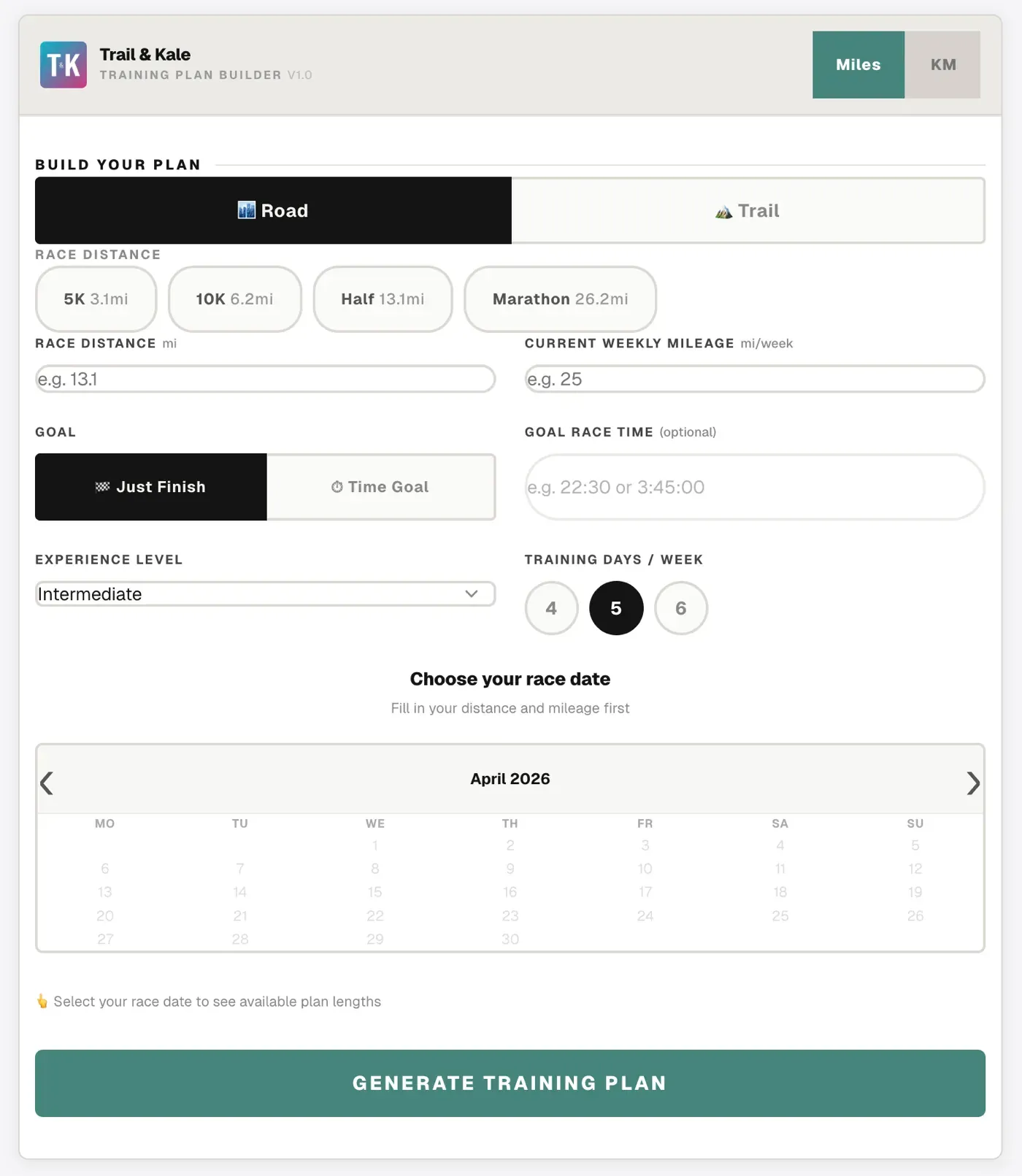
Select Road or Trail, then choose your race distance from the presets or type it in manually.
Enter your race date: the calendar shows the earliest realistic start date based on your distance and current mileage, so you know straight away if your timeline is workable.
Select your date and the plan length options appear automatically.
Set your goal: Just Finish for a volume-first plan with effort-based descriptions, or Time Goal to enter a target race time and have every quality session reference that pace.
Fill in your current weekly mileage and select your experience level. Choose how many days per week you want to train: 4, 5, or 6.
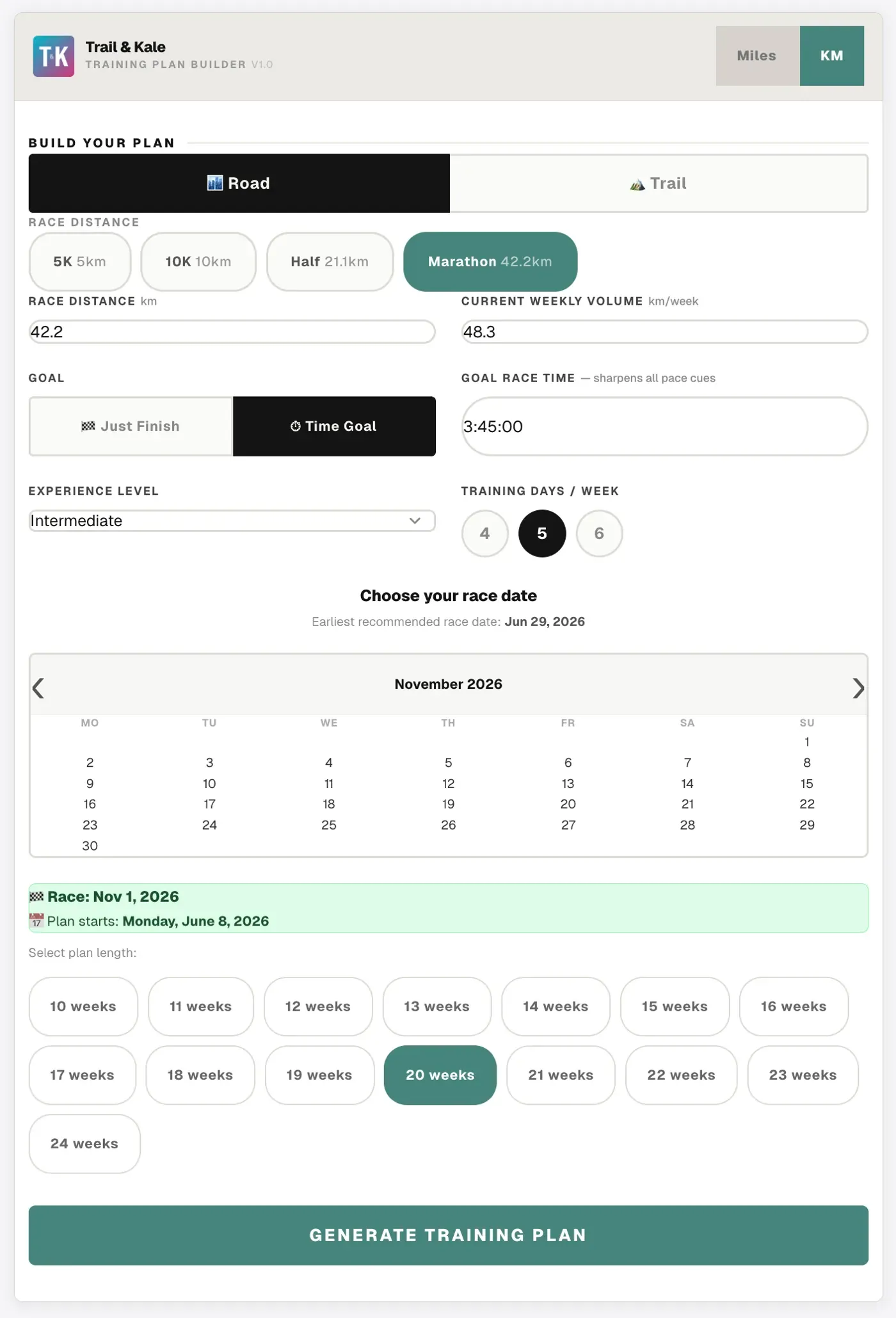
Hit Generate Training Plan. Your full schedule appears immediately.
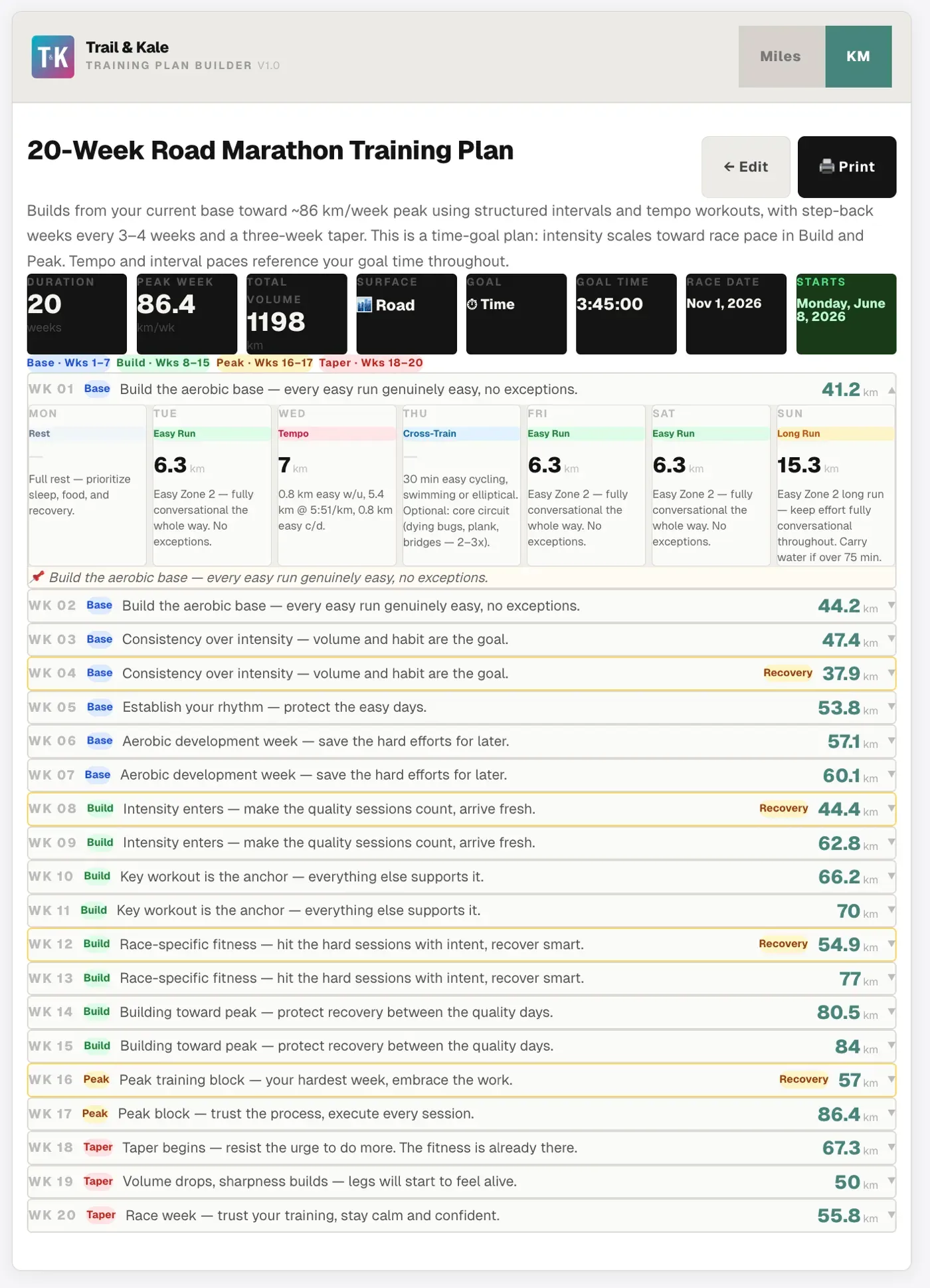
Every week is expandable to show the daily breakdown: workout type, distance, elevation where relevant, and a specific session description for every day.
Hit Print and the plan formats itself onto a single A4 page (see example below).
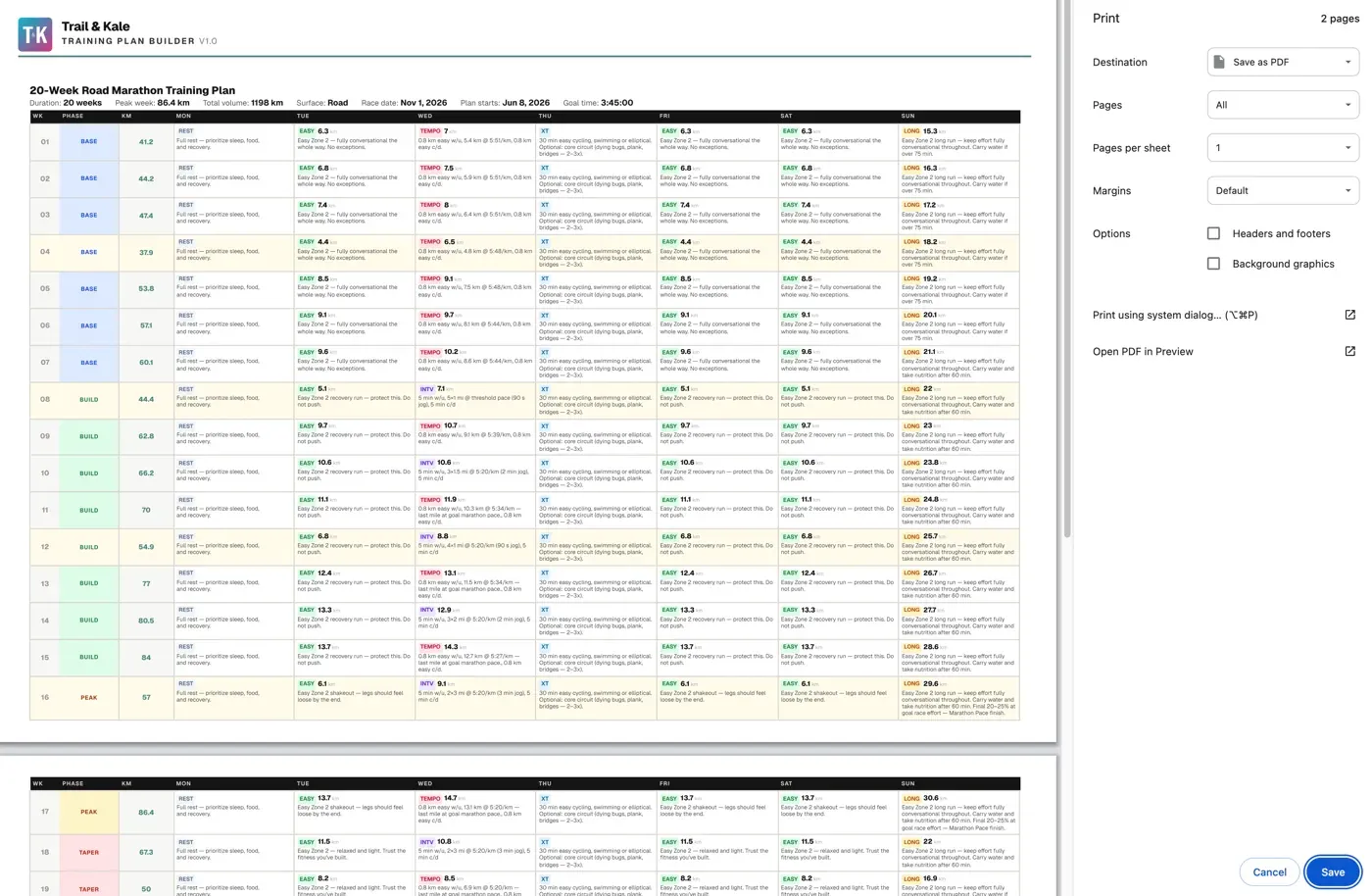
Use it as many times as you like. Different distance, different date, different goal: a completely fresh plan every time.
You deserve the best training tools, and we are delivering for you. All we ask is that you join our community by subscribing to Trail & Kale for free.
⬆ Ready to gain access to OUR tools for Runners & HIKERS?
Subscribe to a free account to reveal our Training Plan Builder and get extra perks like access to exclusive content, training tools, gear roundups, community comments, and our newsletter.
Training Plan Generator Changelog
Written by

Subscribe to new posts
Gear that earns its place, outdoors and at home | Reviews, Roundups, News












Member discussion