
Awe: rediscovering everyday wonder
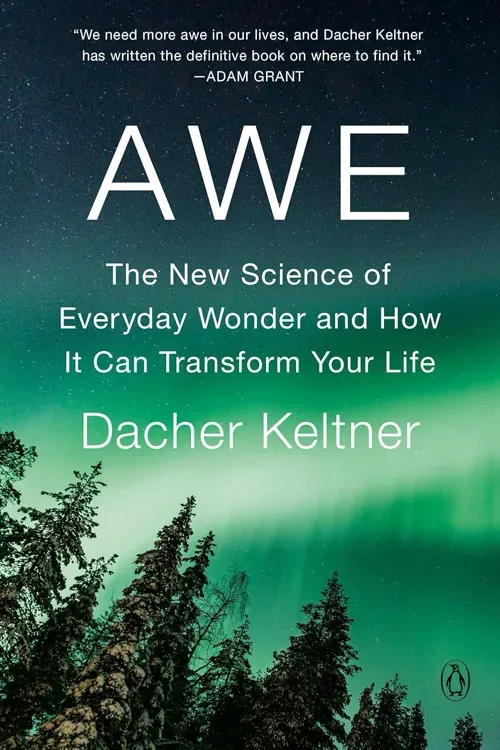
Trail & Kale’s Book of the Month (Jan 2026): A thoughtful look at Awe by Dacher Keltner, exploring how everyday moments of wonder support wellbeing, perspective, and human connection.


Sometimes we sense a shift before we can explain it. A moment slows us down.
Our attention widens. Something ordinary feels unexpectedly meaningful. It doesn’t arrive with fanfare, and it rarely lasts long, but it leaves us subtly changed.
That experience is AWE.
In Awe: The New Science of Everyday Wonder and How It Can Transform Your Life, psychologist Dacher Keltner invites us to take these moments seriously.
Not as rare emotional peaks reserved for extraordinary settings, but as a fundamental part of human experience, one that quietly shapes how we feel, behave, and relate to the world around us.
What this book is really about
At its heart, Awe is an exploration of what happens when we encounter something larger than our current understanding of the world.
Book of the month - Trail & Kale
Book of the Month is a monthly book club that acts like a lens for bigger life questions. We pull out what the book is really about, the ideas that hold up, and what they change in everyday life.


Keltner defines awe as the feeling that arises when we experience vastness and are required, even briefly, to adjust our mental models to take it in, and want to seek an understanding of it.
That vastness can be physical, social, moral, or conceptual. It might come from nature, from other people, from music, or from a sudden insight that rearranges how we see things.
What makes the book compelling is how firmly it grounds this experience in science. Drawing on more than fifteen years of research, Keltner shows that awe is not just a pleasant emotion. It has measurable effects on the body, the brain, and social behavior.
Regular experiences of awe are associated with:
- reduced stress and inflammation
- improved immune and cardiovascular markers
- increased feelings of meaning and connection
- greater generosity, cooperation, and ethical awareness
Awe, in this view, is not an ornamental feeling, it plays a quiet but important role in human wellbeing.
The shared sources of awe
One of the book’s most useful contributions is its identification of common sources of awe, based on thousands of personal stories gathered across cultures.
Keltner finds that awe most often arises from a small set of shared experiences:
- moral beauty, witnessing kindness, courage, or integrity
- collective moments, such as shared rituals, music, or group effort
- nature, including familiar or nearby environments
- music and rhythm
- art, design, and human creativity
- spiritual or contemplative states
- moments involving life and death
- sudden insight or understanding
What stands out is how accessible these sources are. Awe is not limited to rare adventures or dramatic events. It often appears in ordinary settings, when we are open enough to notice.
Awe and the body
A significant portion of the book focuses on how awe affects the nervous system.
Keltner describes awe as a “self-transcendent” emotion.
When we experience it, activity in brain networks associated with rumination and self-focus quiets. At the same time, the body shifts toward physiological states linked with calm, recovery, and social connection.
This helps explain why people often feel steadier, more open, and more connected after experiences of awe. The emotion temporarily loosens the grip of self-concern or ego, and restores a sense of proportion.
Rather than amplifying intensity, awe tends to soften the system.
Why this matters for living well
At Trail & Kale (join our newsletter for free), we often explore practical ways to support a healthier, more grounded life, through food, time outdoors, thoughtful gear choices, and habits that reduce friction.
Awe adds a complementary layer to that conversation.
It suggests that how we perceive our experiences can be just as influential as the experiences themselves.
A few ideas from the book that stayed with me:
Awe restores perspective
When life feels heavy, attention tends to narrow. Problems feel larger and more personal; Awe gently reverses that contraction by placing us in a wider, more connected context.
Awe supports connection
People who experience awe more regularly tend to act more generously and cooperatively. The emotion appears to orient us toward interdependence rather than competition.
Awe is cumulative
The benefits of awe don’t come from chasing extreme experiences. They emerge gradually through repeated, ordinary encounters that remind us we are part of something larger.
These effects are subtle, but they compound over time.
Awe is not something to optimize
One of the most reassuring messages in the book is that awe cannot be forced.
It doesn’t respond well to effort, performance, or self-improvement pressure. Instead, it tends to arise when conditions are right:
- when we slow down enough to notice
- when we spend time in environments that invite perspective
- when we allow ourselves to be moved rather than guarded
- when we loosen the need to control or explain everything
Awe is less about seeking peak moments and more about removing the barriers that keep us from noticing what is already present.
A small practice for this month
Rather than adding something new, try subtracting.
Once this week, spend twenty minutes in a place that feels steady or open to you. Leave your phone behind if possible, and don’t aim to accomplish anything.
Afterward, ask yourself:
- What felt larger than me in that moment?
- What pulled my attention away from myself?
- What lingered afterward?
That’s it. No routine to maintain. Just a brief return to wonder.
A reflective close
Awe is a reminder that not all meaningful change comes from discipline or effort.
Some of the most important shifts happen when we allow ourselves to be humbled, softened, or quietly widened by experience.
In a culture that often rewards certainty and control, awe offers something different. It reminds us that feeling small can be stabilizing, and that connection often arrives when we stop trying to manage the moment.
So here’s the question I’m carrying into January:
Where in my everyday life am I moving too quickly to notice what could gently remind me I’m part of something larger?
Sometimes, that reminder is enough. -Alastair
Written by

Subscribe to new posts
and discover the best gear, healthy foods, and life outdoors.










Member discussion