

members only
An end to the upside down cosmos: getting comfortable with “I’m not sure”
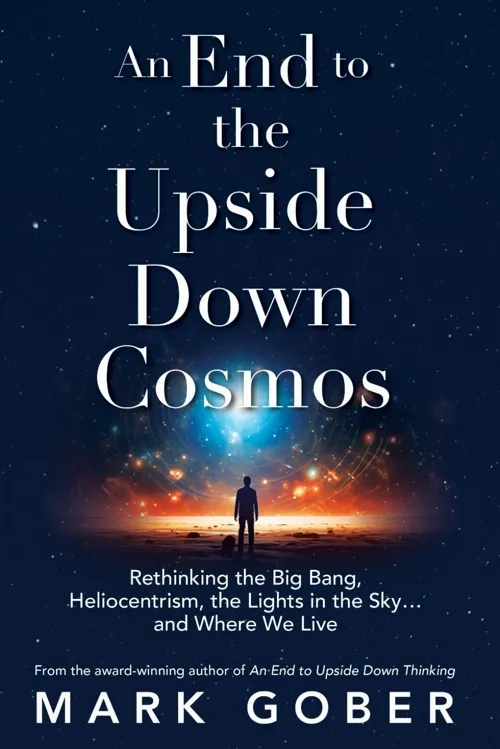
Trail & Kale’s Book of the Month (Feb 2026): A reflective look at Mark Gober’s challenge to “consensus cosmology”, and the deeper question underneath it: how do we decide what’s true?
Sometimes the most disruptive books aren’t the ones that “teach” you something new.
They’re the ones that mess with your relationship to certainty.
Not in a chaotic way. More like… they quietly point at a few assumptions you’ve been living inside of, and ask: When did you decide this was settled? And what would it take for you to revisit it?
That’s the energy of An End to the Upside Down Cosmos.
If you purchase through links in this article, we may earn a small affiliate commission. For exclusive content, our newsletter, and more perks, become a member, it's free! -The Trail & Kale team ✌🏼
Quick details
- Author: Mark Gober
- Paperback: 312 pages (published Aug 28, 2024)
- Audiobook: ~7.5 hours (released Sep 24, 2024)
What this book is really about
On the surface, the book is a direct challenge to the standard story most of us inherit about the universe: the Big Bang, an expanding cosmos, Earth orbiting the Sun, and the broader idea that we occupy no special place in the universe.
But I don’t think it works best as a “cosmology book” in the normal sense.
I read it more like a stress test for worldview building.
Gober’s angle is basically that if mainstream physics admits there are foundational unknowns (he points especially to dark matter/dark energy and the lack of a complete “theory of everything”), then we should be willing to re-check how confident we are about the big-picture model we tell ourselves is airtight.
Book of the month - Trail & Kale
Book of the Month is a monthly book club that acts like a lens for bigger life questions. We pull out what the book is really about, the ideas that hold up, and what they change in everyday life.
He also states he’s not offering definitive replacements for every piece of the model, and that sometimes identifying what isn’t solid is valuable on its own.
Why it feels so provocative (even if you don’t agree)
Because this isn’t a debate about one niche detail.
It’s about the frame.
Most of us don’t hold “Big Bang” or “heliocentrism” as hypotheses we’re actively evaluating. They’re more like background reality, the 'wallpaper' so to speak.
So when someone pulls on that thread, it can feel like an attack on intelligence, education, identity, even social belonging.
But I think there’s a more useful way to engage with it:
Not as “Is he right?” but as “How do I know what I know?”
That question is uncomfortable… and also kind of stabilizing, once you let it be normal.
A steady way to read it (without getting dragged around)
This is the approach I’d recommend if you’re curious but don’t want to end up down an internet rabbit hole at 1 a.m.:
- Separate observations from interpretations. “We measure X” is different from “therefore the universe must be Y”.
- Track the chain of inference. Where does the book move from data → model → meaning? Which step feels strongest? Which step feels like it leans on philosophy, not measurement?
- Notice what’s being argued. Sometimes a critique shows that a common explanation is overstated… without proving the opposite explanation is true.
- Keep your “change my mind” bar consistent. If a claim would require overturning mountains of evidence, it should require mountains of better evidence, not just suspicion or rhetorical confidence.
This way, the book becomes what it’s best at (in my opinion), a mirror for how we process uncertainty.
A quick reality check from mainstream cosmology (so we don’t lose the plot)
It’s also worth holding two things at once:
- Mainstream cosmology isn’t pretending everything is solved. For example, space agencies like NASA openly describe dark energy as something we know exists through its effects, while still not knowing what it is in any deep way (and it’s thought to make up roughly ~70% of the universe).
Dark matter is similarly treated as being “inferred from gravity measurements” rather than directly observed in the way everyday matter is. - But the Big Bang framework has multiple, independent lines of support.
A big one is the cosmic microwave background, which missions like European Space Agency’s Planck have mapped in detail as relic radiation from the early universe.
And NASA’s own explainers summarize the Big Bang model as the best-fit story for a universe that has expanded and evolved over time, anchored by observations like expansion and early-universe light.
Even within that mainstream picture, there are live debates and tensions (like the “Hubble tension”, where different measurement methods don’t perfectly agree on the universe’s expansion rate).
So I’m not reading books like this as “science vs. truth.”
I’m reading them as a reminder that science is a method, and the story we tell the public is always a simplified layer on top of ongoing work.
Why this matters beyond astronomy
Here’s the part I think fits Trail & Kale readers best.
Whether or not you buy Gober’s arguments, the emotional experience of the book is basically this:
How do I live when reality feels less settled than I thought?
For a lot of us, health and wellbeing aren’t just about what we eat or how we get after adventurous experiences. They’re about whether we feel grounded in the world and the toll that puts on our mindfulness and mental health.
And weirdly, you don’t always get that groundedness from “being certain”, sometime the simple act of having a 'belief' in something is enough.
Sometimes you get it from knowing you can meet uncertainty without panicking, dismissing, or clinging.
A reflective close
I don’t think this month’s book is going to be for everyone.
But if you’ve ever felt that quiet itch of “we might be missing something”, it’s an interesting companion. I always ask myself big questions like "well, if the big bang theory is true, what was there before it happened?"
It's a good one to read, not because it hands you a new reality, but because it forces you to notice how much of your reality is built from secondhand "certainty".
So here’s the question I’m carrying into February:
Where in my life am I confusing “commonly repeated” with “deeply understood”?
-Alastair
Written by

Subscribe to new posts
and discover the best gear, healthy foods, and life outdoors.












Member discussion